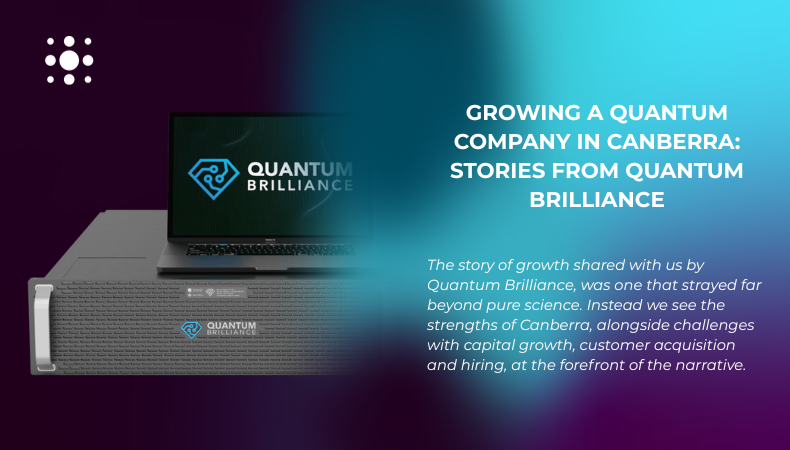
We sat down with Quantum Brilliance: a Canberra-based quantum hardware team, who specialise in creating room-temperature quantum chips, using diamonds, by creating and exploiting defects known as ‘nitrogen vacancy centres.’ We wanted to learn more about how their journey from a proof of concept (POC) to a scalable product with international contracts looked like, what challenges they faced and what advice they had. The story that emerged was one that strayed far beyond pure science, with business, capital growth, customer acquisition and hiring challenges at the forefront of the narrative.
“The first thing is about trying to understand what the business could look like, refining the vision and thinking about your customers,” recalls Jayden Castillo (Chief of Staff & Director of Strategy). “In the early days, programs like CSIRO ON are really valuable for this.” Then, as a deep tech company with long development horizons, seeking funding was a critical enabler for Quantum Brilliance to move forward.
“[A lot of the growth] was really driven through those programmes and some industry grants - like Accelerating Commercialisation [replaced by Industry Grants Program] and ARC Linkage. So, in the early days, it was spinning out a company, hiring a couple of people, and working with researchers who are embedded at universities to try and get maximum leverage out of the resources we had so we could make our first customer delivery.”
Deep tech doesn’t fit the classic startup playbook.
Hardware, scaling up and long R&D cycles can increase the abyss of the ‘Valley of Death’ – the gap between creating a POC and getting into the market. Similar to other startups, approximately 70% of deep-tech companies collapse within 2-5 years.
But intriguingly, university-adjacent startups have proven advantages.
Indeed, a study done in 2021 by Bolzani et al., on university spin-offs showcased that their equity-based linkages, geographical proximity and formal ties significantly enhance performance. In Canberra, especially, with such a high concentration of universities and subsequent spin-offs (take Liquid Instruments, Mini Grav, Skykraft for instance), these benefits become very clear.
However, even with all of these benefits in mind, the universal challenges of finding customers do not dwindle away.
Biliana Rajevic (Director of External Communications & Media Relations) explains that “it was challenging, especially four or five years ago, to actually find people who dare to explore these new technologies … That’s also the challenge when you're starting a company, is [finding] who are the first believers, or first experimenters.”
The road to scalability and national adoption is not short, as Jayden mentions:
“With quantum, [customers] have to be willing to accept that it's a long journey. Sometimes you see those sort of ‘lean-startup’ philosophies that are all about getting a customer quickly as possible … But it’s not so easy with deep tech and hardware in particular.”
Early believers and investors change the whole picture for deep-tech startups. For Quantum Brilliance, it was the Pawsey Supercomputing Research Centre which took on the world’s first on-premise integrated quantum chip.
Rethinking talent:
Quantum Brilliance also had to unlearn some traditional ideas about “top talent”.
“You learn so much along the way,” Jayden reflects. “It’s not always the people with the best resumes who end up being really valuable. It comes down to attitude and motivation.”
Rather than relying on job ads, the company started investing in a talent team to head-hunt specialists in diamond, quantum hardware and advanced packaging, many of whom weren’t actively looking. Internships have also driven progress: some ANU interns have gone on to become core team members.
“You never know where these people are going to come from,” Jayden says. “It’s all about whether they’re the right fit for the role and whether they have the right attitude.”
Biliana Rajevic also points out that diversity of skills is essential for a flourishing startup.
“As quantum becomes more commercial, you’re going to need account managers. You’re going to need sales people. You’re going to need marketing managers,” she says. A lot of the focus, as she explains, is on “having conversations with potential users and brainstorming how we can help them.”
So, people-people who can conduct such market research, connect with ecosystems, bring fresh ideas home, and make sure the business runs and grows sustainably, are essential.
But why Canberra?
As we’ve mentioned above, university spin-offs have specific advantages. When it comes to Quantum Brilliance, Canberra gave them an unusually rich launchpad and the ability to design and patent technology that resolves many of the customary issues with diamond quantum technologies.
For Canberra’s advanced tech ecosystem, the narrative expands beyond just quantum. Companies like Quantum Brilliance sit at an intersection and provide a great diversity of thought, expertise and opportunities for cross-collaboration. Specifically mobile, room-temperature quantum chips that can one day be integrated in vehicles, robots or even satellites, open new frontiers in sensing and advanced computation.
In a city with organisations like the Canberra Cyber Hub, explicitly and actively backing cyber, space and quantum growth, Jayden’s and Biliana’s lessons and stories are a valuable blueprint for Canberra’s next generation of advanced-technology companies, whilst their work opens a big door for cross-industry collaboration and research.