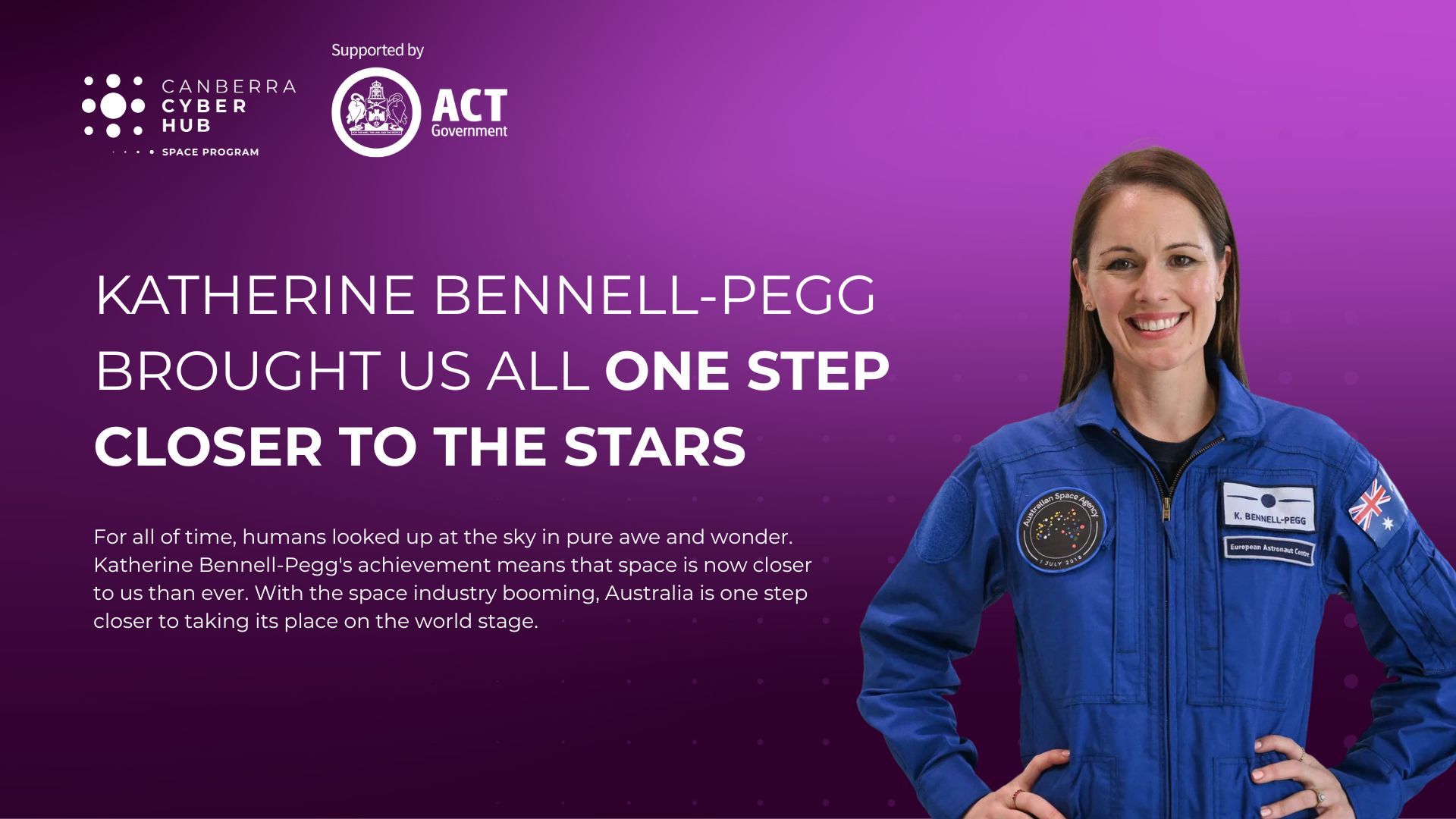
Katherine Bennell-Pegg isn’t just the 2026 Australian of the Year and the first professional astronaut to officially represent Australia. No; Katherine is an inspiration for many young children, adolescents, and current working professionals from all around Australia, who look up at the night sky in pure awe and wonder.
Marvelling at, and admiring the sky. It's one of the most common human experiences, uniting us across all borders, across all time.
Take the Emu in the Night Sky as an example. This Dreamtime story reaches as far as 65,000 years back, where it helped hunters understand seasonal behaviour of Emus. On the other side of the world, one of the first mathematical interpretations of the universe (the Harmony of the Spheres), suggested that the universe was playing harmonious chords in perfect ratios, to be heard by the soul. The cosmos in all its unfathomable size, has continued to be at the center of what it means to be human, what it means to explore.
So, when we heard that an Australian became an astronaut under our very own flag for the first time, it sent irrevocable waves across the country for all those who look up and wonder our place in the stars.
But how did this come to fruition?
Australia had no space agency, no human spaceflight program, and no clear pathway for astronauts. The Australians who had made it to space before Katherine, had done so flying under the American flag.
Katherine was the first of us, the one who walked this road solo and showed us that things are changing. She graduated in 2024 from the European Astronaut Centre in Germany as a fully qualified astronaut, going up against more than 22,500 applicants worldwide.
Katherine’s path to becoming an astronaut was neither linear nor straightforward. She graduated from the University of Sydney with a double degree in Aeronautical Engineering and Physics, winning the prize for the first-placed undergraduate thesis. After her academic endeavours, she served in the Australian Army Reserve, developing operational discipline and team resilience that technical training alone could not produce. She then spent fifteen years as a space systems engineer across six countries, completing space studies at NASA's Ames Research Center and then working at Airbus in Germany on missions spanning robotics, human spaceflight, and Earth observation.
She wasn’t just building up a robust resume with the goal of becoming an astronaut. As she told us, she was just doing work she loved.
"I followed a career path I would have loved anyway," she tells us, "being part of great teams, helping to solve mysteries about the universe."
So, the biggest lesson here and what translates onto anyone who is reading this, is that for Katherine, becoming an astronaut was the outcome of a fulfilling career, not the starting point.
For millions of people across the country, Katherine’s story successfully highlights one clear thing: an unconventional career is neither risky nor reckless. It is the sustained pursuit of meaningful, fulfilling work that, when done across a multitude of domains, makes you irreplaceable.
“[My career was] not like a peak or a mountain, but a mountain range. When you climb one peak, you see the rest in the distance."
To many, the pursuit of space seemed to be akin to science fiction. But in reality, space is critical infrastructure, underpinning GPS navigation, weather and fire tracking, agricultural monitoring, secure communications, disaster response and so much more. In 2023, a single satellite failure brought farming equipment across Australia to a standstill during peak harvest. As Katherine said, this was something that farmers "had never considered."
"Space is the invisible utility," Katherine says, "and it underpins our society."
What’s more exciting is that the applications of space technologies, as she argues, are still actively being discovered. And to top it all off, humanity is returning to the moon. The Artemis II mission around the moon was watched by 54% of the Australian population, sparking the next wave of innovation and imagination, much as Apollo did in the 1960s. What that produces in materials, medicine, and electronics, cannot yet be fully imagined.
Australia's space sector is expanding at an exponential rate to meet this moment. We’re contributing to high-speed communications, earth observations, fundamental research, rover transport, and much more. There’s a myriad of roles to fill right on our soil, with an estimated 20,000 new job openings by 2030.
For those who look up at the sky in pure astonishment, the emerging space sector means that you can take one step closer to being a part of it all.
In such a boom, it’s essential that we support the future generations to not lose that spark, to keep the momentum going. Currently, year twelve physics enrolments are at their lowest on record, mathematics enrolments are falling and gender gaps in STEM performance surface as early as year four.
Seven out of ten school children say they want to go to space, but as grown-ups, how many of us have upheld that aspiration or even the aspiration to get involved in space discovery?
"Curiosity and talent for space is just everywhere," Katherine says. "Aspiration isn't, though, because opportunity isn't."
As previously highlighted, this gap of opportunity is not a product sector stagnation, but rather visibility and support; Katherine recalls a friend telling her that her four-year-old daughter refused to wear an astronaut costume because, “astronauts are for boys”. Once she was shown a photo of Katherine’s graduating class of three women and three men, the costume went back on.
"Representation does matter," Katherine explains. "Being there and being who you are helps people to see themselves in that future."
What comes next
Katherine is, as of early 2026, still waiting for her mission assignment.
But as Australia's 2026 Australian of the Year, as the first person to qualify as an astronaut under Australia's flag, as someone who has shown us that nothing is impossible, she has already inspired a whole generation to never stop looking up.
"For me now, it's so much bigger than me wanting to be an astronaut," she says. "What I care about is going up there to play my part in the discoveries, to help Australian science access space, to inspire the next generation, and for Australia to take its place on the world stage."