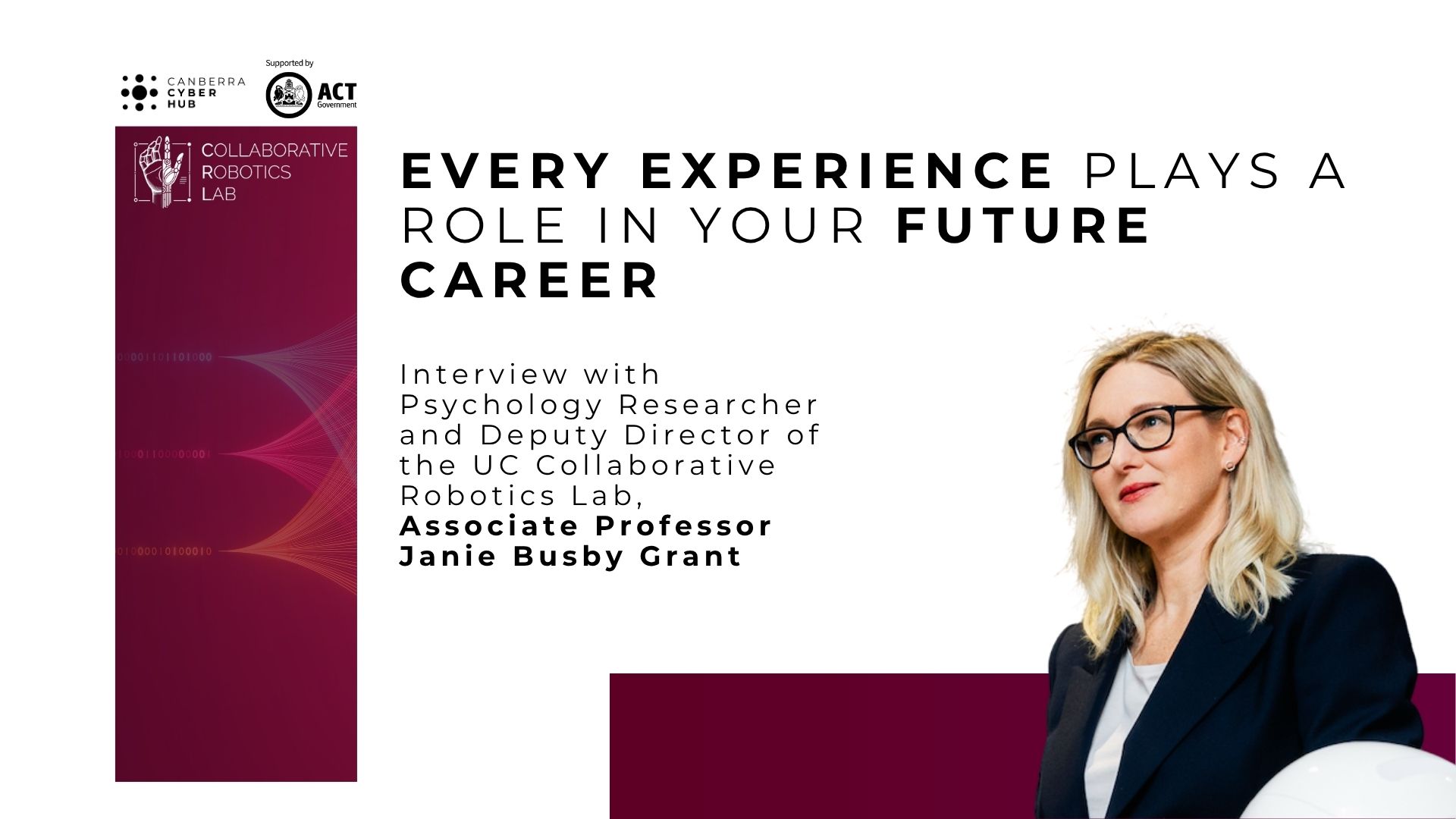
As the future of work rapidly evolves, tertiary students, recent graduates, and career-changers face a daunting question: how do you stand out in a crowded job market? According to Psychology Researcher and Deputy Director of the UC Collaborative Robotics Lab, Associate Professor Janie Busby Grant, the secret isn't just relying on the title of your degree. Instead, it is about combining your unique skills, embracing interdisciplinary learning, and being outstandingly proactive.
Here are some main takeaways from our conversation with Janie:
The Power of the Interdisciplinary Approach
Janie’s own career journey is a perfect example of how branching outside of your main academic principle can have a great payoff. While completing her undergraduate degree in psychology, she intentionally branched out into IT, robotics and programming.
"I was always interested in this potential intersection between technology and human behaviour," she explains.
This blend of disciplines gave her a distinct advantage when collaborating with engineers and tech professionals later in her career.
"What that has given me, is a new perspective. It's given me language that I need, so I can talk to people from those backgrounds [and areas of expertise]".
The lesson here is that your past experience is never wasted; every experience you’ve had, every field of study or work you’ve participated in, has helped shape you. Every individual brings in a unique perspective and a unique language, which is exactly what you can leverage to enter new fields and bring your areas of interest together.
Translating Your Academic Skills
Many graduates worry if their specific degree will easily translate to a job title. Janie and her research team recently addressed this in a paper, analysing over 5.1 million job ads, to understand how psychology skills map across industries.
"Becoming a psychologist is a very specific pathway. Only between 10 to 30% of psychology graduates actually become psychologists," she notes.
By using a machine learning model to map core competencies, they found surprising job fits; for example, did you know psychology skills map well onto a vast array of diverse jobs, including User Experience Designer, Intelligence Officer, Community Development Officer, or Warehouse Management Administrator?
Why?
"It turns out you need really good understanding of systems and how human behaviour interacts with those systems in a whole range of jobs. You need good report writing, communication, and understanding of culture and ethics," she says.
So, intriguingly, although it may seem like a psychology degree sets you up to be a psychologist in the future, it actually provides so much more. Those soft skills you learn and experience you get through your degree actually maps onto much more than one may initially expect.
Bring Your Hobbies to Work
To truly stand out, Janie emphasises that you need to bring your whole self to your career.
"It's not a matter of just putting your degree on your CV. It's about talking about what you can do.”
Whether you’ve been part of any clubs or societies, or participated in CTFs, extracurricular competitions, or you just have a side passion that might seem irrelevant at first, those extra pursuits and skills matter. And that’s the case even if those skills don’t seem like they’re directly applicable to the goal of the job you’re applying for.
"Anything else that you've done for fun might actually boost your skill set and be something that people want in the workforce," she explains. "That combination is really what makes you unique in the workforce".
Diversity of Thought and Experiences
In cutting-edge fields like robotics, diverse teams are essential for solving complex problems. Janie notes that the most successful projects rely on a wide array of voices.
"Having all of those different voices in this space is incredibly useful and incredibly informative.”
This extends beyond professional backgrounds to personal and cultural diversity. Co-design is a big conversation in the current technology landscape, and diverse teams bring across that experience and background, which is so essential to ensuring that the product serves all intended audiences, as intended, from the get-go.
Be Proactive
Ultimately, you cannot just wait for opportunities to come to you. When we asked Janie what she would have done differently when she was a student, the advice was simple and clear; take initiative.
"I think I would have been more proactive," she reflects. "I didn't realise back then, I think, that you could email someone out of the blue and say, 'Hey, this is my skill set. Could I have a chat about doing a project with you?'".
Your chosen field will naturally send you down a path of least resistance, but carving out an innovative career will often include stepping off that path.
"Read widely, attend things, be interested," Janie urges. By embracing your diverse interests, translating your core skills, and bravely reaching out to industry professionals, you can confidently forge a unique place in tomorrow's workforce.